
6 Signs Your Water Softener Has Stopped Working
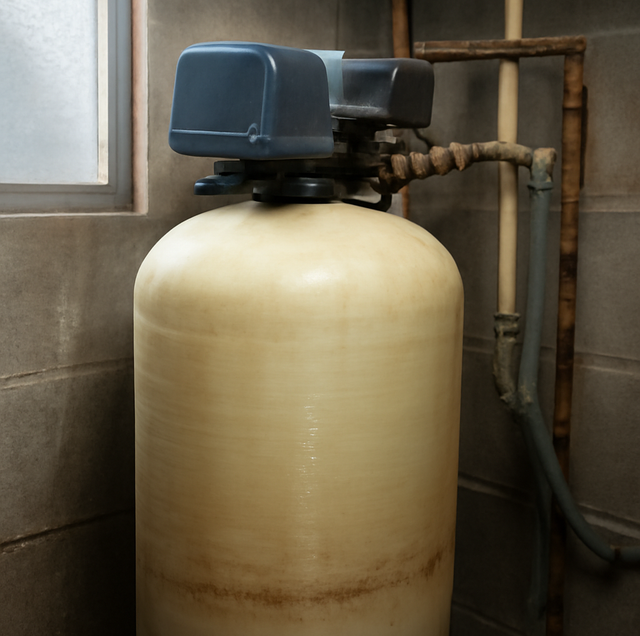
It is easy to assume that when hardness symptoms come back- spotty glasses, a filmy soap scum ring, scale creeping up the showerhead again- the whole softener has worn out and needs to be hauled to the curb. That assumption is usually wrong. A softener that is still humming along, still cycling on schedule, can be doing almost nothing useful inside, and the fix is often something a technician clears in one visit rather than a full replacement.
What the Softener Is Actually Doing in There
A softener works by ion exchange. Resin beads inside the tank hold sodium (or potassium) ions, and as hard water passes through, the beads swap out calcium and magnesium for that sodium, which is what leaves the water soft. Over time, those beads fill up with calcium and magnesium and need to be flushed clean, a process called regeneration, which uses a strong brine solution pulled from the salt tank to strip the calcium and magnesium back off and recharge the resin with fresh sodium. When any part of that cycle breaks down, calcium and magnesium start passing straight through untouched.
Sign 1: Hardness Symptoms Return While the Unit Keeps Running
This is usually the first thing anyone notices: the resurgence of spotting on dishes and glassware, a soap that will not lather the way it used to, or a chalky film building on faucets and shower doors again. None of this proves the unit has failed structurally. It proves the resin is not being regenerated with brine the way it should be, and several distinct reasons can happen, each with its own fix.
Sign 2: A Full Salt Tank That Never Seems to Get Used
Open the brine tank and the salt level looks about the same as it did last month, even though the softener has supposedly been regenerating on schedule. The usual explanation is a salt bridge: a hard, crusted layer forms across the top of the salt, and a hollow air gap opens up underneath it. Water still enters the tank and can still trigger a regeneration signal, but it never actually touches enough salt to dissolve into a brine strong enough to recharge the resin. The tank looks full because it is, technically, but the salt sitting above the hollow gap is doing nothing.
Sign 3: Wet, Sludgy Salt Instead of a Hard Crust
The opposite failure looks and feels different. Instead of a hard crust with air underneath, the salt turns into a thick, mushy sludge at the bottom of the tank. This usually comes from very fine or low-purity salt breaking down faster than it dissolves, or from high humidity in the equipment space keeping the salt perpetually damp. That sludge can clog the injector, sometimes called the venturi or eductor, the small nozzle that actually draws brine up out of the tank and into the resin during regeneration. A clogged injector stops brine delivery just as completely as a bridge does, even with plenty of salt sitting right there.
Sign 4: The Resin Bed Itself Has Simply Worn Out
Resin beads do not last forever. Years of regeneration cycles gradually reduce their exchange capacity, and certain conditions accelerate the wear: chlorine exposure breaks down resin faster on treated municipal supplies, while iron in the raw water coats and fouls the bead surfaces on private wells, cutting their effective capacity long before their theoretical lifespan runs out. A worn bed still regenerates on schedule and still produces some softening, which is why this failure often shows up as water that is only partly soft, hardness knocked down but not fully gone, rather than a sudden hard return to full hardness.
Sign 5: Iron Staining Creeps Back In
If iron was ever part of why a softener was installed in the first place, watch for its return specifically, not just general hardness. Iron fouls resin at a different rate than calcium and magnesium do, and once enough iron has coated the beads, the softener starts letting iron through well before it stops handling ordinary hardness. Rust-colored staining reappearing in the toilet tank or around a faucet aerator, even while glassware still looks reasonably clear, points to iron fouling on the resin rather than a general capacity failure.
Sign 6: Salt or Water Usage That Does Not Match the Household
A control valve or timer that has started malfunctioning shows up in the utility bill before it shows up in the water. A unit regenerating far more often than the household's actual water use justifies burns through salt and wastes water without improving anything, while a stuck valve that does not regenerate at all quietly stops softening altogether. Either direction is worth a look at the control head itself, separate from the tank and resin.
Sorting a Fixable Fault From a Truly Worn-Out Unit
Most of what shows up on this list is serviceable: breaking up a salt bridge, clearing a clogged injector, switching to a cleaner salt product, or adding fresh resin to restore lost capacity. What is not usually fixable in place is a cracked brine tank, a control valve body that has physically failed, or a resin tank that has developed an internal leak. Telling those apart is exactly what a technician's inspection is for, rather than assuming the worst from spotty glassware alone.
Frequently Asked Questions
Take a broom handle or a similar rigid rod and press down gently into the salt at a few spots around the tank. A bridge feels like a hard crust that resists at first and then gives way into open space underneath, since that hollow gap is the whole problem. Mushy salt feels soft and gives resistance more like wet sand all the way down, with no hollow pocket to break through. Either finding points at a different fix: breaking up a bridge restores contact between water and salt, while mushy salt usually means clearing the injector and switching to a cleaner-dissolving salt product going forward.
It does, more than most people expect. High-purity pellet salt dissolves more evenly and leaves less insoluble residue at the bottom of the tank than coarser rock salt, which is one of the more common contributors to both bridging and sludge buildup over time. Solar salt sits in the middle, dissolving cleanly but sometimes more slowly than pellets. None of this is about brand, just purity and form, and switching to a cleaner-dissolving product is often enough to stop a bridging problem from coming back after it is cleared.
Yes, and it is a bigger factor on private wells than on treated municipal supplies. Iron particles coat the resin beads and reduce their available exchange sites, so a softener handling iron-heavy water loses effective capacity faster than the same unit would on cleaner water, even with identical regeneration settings. Installing iron filtration ahead of the softener protects the resin from that fouling and is usually the difference between a softener that holds its capacity for years and one that needs constant attention.
The exchange capacity keeps shrinking with every regeneration cycle, so the softener needs to regenerate more frequently to hold the same level of softness, burning through more salt and water for a shrinking return. Eventually, the bed loses so much capacity that even a fresh regeneration softens water for only a few hours before hardness starts breaking through again. Replacing the resin at that point restores the tank to close to its original capacity without needing to replace the whole system.
It can, and it is worth flagging separately from the signs above. Fine, uniform granules showing up in faucet aerators or screens can mean a cracked internal distributor tube inside the resin tank is letting whole resin beads escape into the household plumbing rather than staying contained where they belong, which is a mechanical failure inside the tank itself. It is one of the few things on this list that points toward a hardware repair rather than a maintenance fix.
Age and repair history matter as much as the specific failure. A unit whose resin was already replaced once and is showing the same capacity loss again within a couple of years is usually dealing with an underlying fouling source- iron, sediment, or excess chlorine- that a second resin swap alone will not fix, so the source needs addressing first or the pattern just repeats. A control valve that is an older model with no replacement parts still made for it is the other common tipping point, since a valve that cannot be repaired forces a decision regardless of how the rest of the unit is holding up.
Telling a Maintenance Fix From a Real Failure
A softener that is still cycling but no longer softening is more often dealing with a salt bridge, a clogged injector, a resin bed nearing the end of its exchange capacity, or iron fouling than it is truly finished. Each of those leaves its own signature: a hollow salt tank, a sludgy brine well, partial softening instead of none, or iron staining creeping back before general hardness does, and each points toward a specific, usually serviceable fix rather than a full replacement.
If your softener is running but hardness or iron staining is creeping back, have it inspected - a technician can check the salt tank, injector, and resin bed to find out whether it needs a repair or a replacement. Pump Repair Services serves Apopka and the surrounding Central Florida area. Call (407) 625-5499.
