
Rusty Orange Stains in Your Sink? It’s Iron in the Well
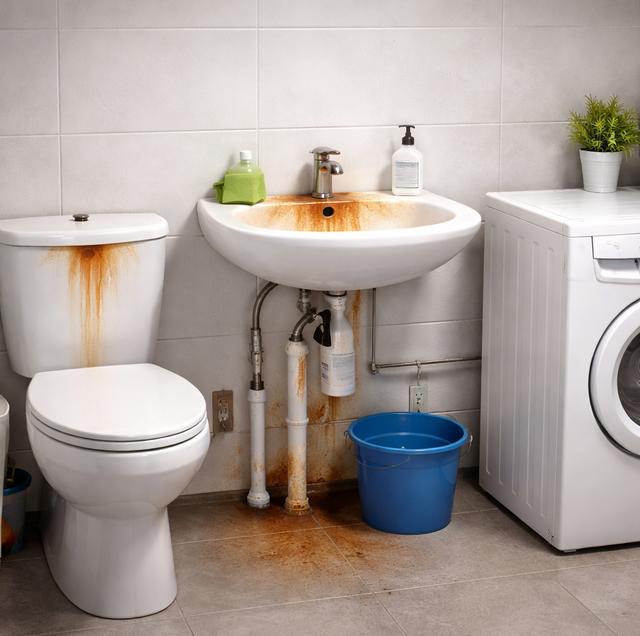
You lift the lid on the toilet tank and the inside is coated in orange-brown film. There is a rust ring in the bowl that comes back a day after you scrub it, a tan streak under the faucet, and a stain in the tub below the shower head. A load of white towels came out of the wash with faint orange freckles. Nothing looks wrong when you fill a glass at the kitchen sink, so the stains feel like they appear out of nowhere. They do not. Your well is delivering iron, and the porcelain is just where you finally see it.
Here is the part that trips people up: the water can leave the ground clear and still stain everything it touches. The color is not in the water when it comes out of the tap. It develops afterward, on contact with air and with the surfaces in your home. That one fact explains why the stains show up where they do, and why the fix is rarely a matter of scrubbing harder.
Clear at the Tap, Rust on the Porcelain
Iron dissolves in groundwater in a form called ferrous iron, sometimes called clear-water iron. Deep water holds little oxygen, and in that oxygen-poor state the iron stays fully dissolved and invisible, the same way sugar disappears into tea. Water in this condition can carry a surprising amount of iron and still pour out of the tap looking clean.
The moment that water meets oxygen, the chemistry changes. Ferrous iron gives up electrons to the oxygen and converts to ferric iron, the rust-colored, undissolved form. Those particles are what settle onto the toilet tank, cling to the bowl, and bond into fabric in the wash. It happens when water splashes into a sink, sits overnight in a tank, or sprays across a driveway from an irrigation head and dries in the sun. The reaction also speeds up as the water warms and as its pH rises, which is why a hot-water fixture or a toilet tank that sits still for hours often stains worse than a cold tap you run constantly.
For scale, the EPA sets a secondary guideline for iron at 0.3 parts per million (ppm). That is an aesthetic recommendation about staining and taste, not a health limit, and it is low: at three-tenths of a ppm, iron already leaves visible orange marks and a faint metallic taste in coffee and ice. Many private wells run several times that, so a well can sit well over the staining threshold while the water in the glass still looks fine, because the iron has not oxidized yet.
Sulfur is a separate matter. If the water also smells like rotten eggs, that is hydrogen sulfide gas, a different problem with its own fix, though iron and sulfur often ride along together in the same well.
When the Stains Run Brown or Black
Not every stain is orange. If the marks skew dark brown, gray, or nearly black, the likely culprit is manganese, iron's chemical cousin. Manganese behaves the same way in the ground: dissolved and invisible under low oxygen, then oxidized into dark specks once it meets air. It tends to show up as black flecks in an ice cube, a dark film in the dishwasher, gritty black sediment in the bottom of the toilet tank, or a brownish-black ring rather than a rusty one.
Manganese is even harder to remove than iron and shows at lower concentrations. The EPA's secondary guideline for it is 0.05 ppm, roughly a sixth of the iron threshold. Many wells carry both minerals at once, which is why a stain can read as a muddy orange-brown rather than a clean rust. A water test that reports iron and manganese separately, in ppm, is the only way to know the split, and it matters because manganese needs a stronger push to oxidize than iron does.
The Slimy Kind: Iron Bacteria
There is a third source that looks different from either mineral stain. If you find a slimy, gelatinous orange or reddish sludge in the toilet tank, around the well cap, inside the pressure tank, or as an oily-looking sheen on standing water, you are probably dealing with iron bacteria. These are naturally occurring organisms that feed on dissolved iron and manganese and, in the process, wrap themselves in a rusty, sticky biofilm.
Iron bacteria are not a health threat by themselves, but the slime spreads: it clogs well screens, coats pipe walls, fouls the pressure switch and check valves, and can plug a sediment filter in weeks. It also gives off musty, swampy, or oily odors that people sometimes mistake for the sulfur smell. A filter alone rarely solves it, because the colony keeps regrowing upstream. This is the source most likely to need disinfection rather than just filtration.
Reading Your Own Water Before Anyone Arrives
You can narrow the cause with a few minutes and a clear glass. Each check points toward a different fix, so it is worth running them before you shop for equipment.
Fill a clear glass and let it stand: If the water is clear when poured and turns cloudy, then orange, as it sits for fifteen to thirty minutes, you have dissolved ferrous iron oxidizing in front of you. If it comes out already rusty or cloudy, the iron is oxidizing before it reaches the tap, often in an older galvanized pipe, an aging pressure tank, or a well that is drawing in air.
Look at the color of the stain: Orange to reddish-brown points to iron. Dark brown to black points to manganese, or to both minerals together.
Feel for slime: Wipe the inside of the toilet tank or the well cap. Gritty and mineral says iron or manganese oxide. Slippery, stringy, and gelatinous says iron bacteria.
Check whether a softener is already involved: If you have a water softener and the staining got worse over time, the resin bed may be fouled with iron it was never meant to handle. Compare an outdoor spigot ahead of the softener against a treated indoor tap.
Those four observations usually sort the problem into one of three buckets before a technician measures anything. A pro then confirms it with a water test that reports iron, manganese, pH, hardness, and often a bacteria check, because the numbers decide which treatment will actually hold.
Matching Treatment to the Water
No single device handles every version of this. The right system depends on which mineral you have, how much, whether bacteria are involved, and what the pH is doing. A few common paths:
Oxidizing air-injection iron filter: For moderate to high dissolved iron, an air-injection filter pulls a pocket of air into the top of the tank, so the iron oxidizes on contact with oxygen, then a bed of media catches the resulting rust and rinses it away on a backwash cycle. It uses no chemicals and handles iron well, especially when some sulfur rides along.
Catalytic or greensand media: Manganese greensand and similar catalytic filter media coat the mineral grains with a surface that drives oxidation of iron, manganese, and some sulfide at once. Greensand is regenerated periodically with potassium permanganate. This path shines when manganese is in the mix, since manganese is harder to oxidize than iron alone.
A softener for low iron only: A water softener removes hardness by ion exchange, and it can pull out small amounts of ferrous iron along the way, generally when iron is low and still fully dissolved. Push a softener past that, or feed it iron that has already oxidized, and the rust coats the resin, cuts its capacity, and eventually ruins the bed. A softener is a hardness tool that tolerates a little iron, not an iron filter.
Shock chlorination for iron bacteria: When the problem is bacterial slime, the reset is shock chlorination, circulating a strong chlorine solution through the well, pressure tank, and lines, holding it, then flushing it out. It knocks the colony back, but the organisms drift in from the aquifer, so heavy cases often need repeat treatment or a continuous chlorine injection system feeding a filter.
Two details decide whether any of this works. The first is pH: oxidation slows in acidic water, so a low-pH well often needs a neutralizing step ahead of the iron filter or the media never does its job. The second is order of operations: iron and bacteria treatment belongs ahead of a softener, so the resin never sees the load that would foul it. Sizing the system to a real water test, not a guess, is what separates a fix that lasts from one that stains again in a season.
Where the Stains Are Pointing
Rust rings and orange laundry are not a cleaning failure. They are a readout of what your well is carrying: dissolved iron that turns to rust in the open air, manganese that darkens to brown or black, or iron bacteria that build slime as they feed. The stain's color, its texture, and how the water behaves in a glass narrow the cause quickly, and a water test settles it with numbers. From there, the treatment follows the water: an oxidizing filter for real iron loads, catalytic media when manganese joins in, disinfection for bacteria, a softener only where iron is light. Chase the stain with the wrong single gadget, and it keeps coming back. Match the system to what the test actually finds, and the porcelain stays white.
Frequently Asked Questions
Chlorine bleach is an oxidizer, and rust is already oxidized iron, so bleach does not lift the stain; it sets it and can deepen the color. The same goes for many all-purpose cleaners. Acidic cleaners work better on existing marks: a product built on citric, oxalic, or phosphoric acid dissolves the iron rather than fixing it in place. On laundry, never run iron-stained whites through a normal wash with chlorine bleach, since that can lock the orange in permanently; a rust-specific laundry treatment is the safer route. None of this addresses the source, though, only the marks already there.
Yes. Oxidized iron and manganese build up as scale inside pipes, narrowing them and dropping pressure over time, and the sludge fouls the pump's check valve, the pressure switch contacts, and the tiny ports in dishwashers and ice makers. Iron bacteria are worse for hardware than the minerals alone, because their slime coats the well screen and pump intake and can choke flow at the source. Catching an iron problem early often saves a sediment filter, and sometimes the pump, from premature clogging.
Iron at the levels that cause staining is treated as an aesthetic nuisance rather than a health hazard, which is why the EPA guideline for it is a secondary, taste-and-staining standard rather than a health limit. Manganese is the one to watch more closely: beyond its aesthetic guideline, it also carries a separate health advisory at higher concentrations, and infants are considered more sensitive to it, so a well with heavy manganese is worth a lab test and a conversation about the numbers. Iron bacteria themselves are not classified as a health risk, but their slime can shelter other organisms, which is another reason a bacteria test is useful when slime is present.
That usually means iron is oxidizing in the open air as the sprinkler sprays and the droplets dry on concrete, siding, or the driveway, baking into a stubborn rust film in the sun. A home often stains hardscape outdoors while the indoor plumbing looks cleaner, because the spray exposes far more water surface to oxygen at once. Irrigation-only iron is its own decision, since a whole-house filter to protect a driveway may be more than the situation calls for; sometimes the answer is treatment on the irrigation line or moving spray patterns off the surfaces that stain.
Less than most people expect, but the raw number does not tell the whole story, which is why a good lab report splits iron two ways. Total iron counts everything in the sample; dissolved, or ferrous, iron counts only the clear part still in solution. When most of the total is dissolved, an oxidizing filter is the natural fit, since the job is to convert and catch it. When a large share is already ferric, oxidized before the tap, the water tends to carry visible sediment and sometimes iron bacteria, and a plain softener fouls fast on it. Staining also rides on contact time and pH, not ppm alone: water that sits for hours in a warm, higher-pH toilet tank will mark at a level a fast cold tap would rinse past. So two wells reading the same iron can stain very differently and call for different equipment.
It can, and a gradual increase is worth investigating. A slow rise in iron or staining sometimes tracks a dropping water table pulling from a different part of the aquifer, a well screen or casing starting to corrode, or an iron-bacteria colony quietly growing in the well and plumbing. A pump set low enough to draw in more sediment and air can also speed oxidation inside the system. A fresh water test compared against any older results tells you which way things are moving.
Pin the staining to a cause before buying equipment, with a water test for iron, manganese, pH, and bacteria, and the right oxidizing filter, catalytic media, or disinfection matched to your well. Pump Repair Services serves Apopka and the surrounding Central Florida area. Call (407) 625-5499.
