
Well Pump Runs but No Water? What’s Actually Wrong
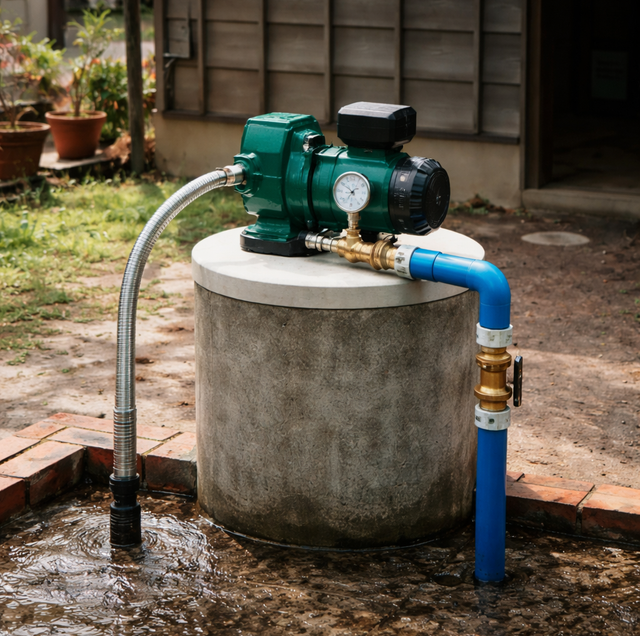
A humming pump and a dry faucet look like a contradiction, but the sound proves only one thing: the motor has power and is spinning. Whether the pump is grabbing water at the bottom of the well, and whether that water survives the trip to the tap, are separate questions the hum cannot answer. Nearly every case traces to a short list of failures between the foot of the well and the aerator on your kitchen faucet.
Picking up water and delivering it are two separate jobs, and a failure in either leaves you at a dry tap with a working motor. So the question splits: is the pump failing to grab water down in the well, or is water lifted and then lost or blocked before it reaches the tap? Sorting your symptoms into those two zones is how you stop guessing.
What the Running Sound Already Rules Out
The hum tells you power is reaching the pump, the breaker is holding, and the motor is spinning. That clears a whole branch of dead-pump problems off the board: a tripped breaker, a burned-out motor, a snapped wire. What remains are the failures where the motor runs fine but water still does not come through, and they fall into two families: the pump cannot get water (the well side) or the water cannot reach you (the delivery side). Keep that split in mind as you read the table below.
Quick Reference: Symptom, Likely Cause, Next Step
| What you notice | Likely cause | What to do |
|---|---|---|
| Faucet spits air, then trickles, worse in dry stretches or during irrigation | Well ran low or dry; pump pulling air | Shut the pump off, let the well rest, have the static water level checked |
| Pump runs nonstop, pressure gauge never climbs | Cracked or leaking drop pipe dumping water back down the well | Have the pump pulled and the drop pipe inspected |
| No water after the system sat idle, jet pump won't hold suction | Failed foot valve or check valve, lost prime | Have the check and foot valve tested and the pump re-primed |
| Gritty water for weeks, then flow fades to nothing | Clogged intake screen or worn impeller not building lift | Have the intake, screen and pump end checked |
| No water right after a repair or a dry run | Air lock in the line or pump housing | Bleed the trapped air and re-establish flow |
| Outside spigot has water but the house does not | Closed valve, clogged filter, or an air-bound tank downstream | Check the main valve, whole-house filter, and pressure tank |
The Well Ran Low or Ran Dry
This is the first thing a tech suspects when a submersible runs but delivers nothing, and it is the most common cause on the well side. Your pump sits at a fixed depth while the water stands at a level called the static water level. When that level drops below the pump's intake, the pump is no longer in water. It pulls air, or a froth of air and water, and a pump churning air cannot build a solid column or any pressure. At the faucet, you get spitting, then nothing.
Water tables move. The level rises when rain recharges the aquifer and falls during a long dry stretch, so treat depth as a year-round variable rather than a single-season scare. The same low reading can be triggered any month by heavy simultaneous demand: running irrigation while the house draws water can pull the level below the intake for a while, then it recovers once the draw stops. A well that comes back after a few hours of rest is the classic signature of a low or dry well rather than a broken part.
A tech confirms it two ways. A draw-down test measures where the water stands and how fast it falls while the pump runs. A clamp meter on the power lead tells the rest: a submersible running on air is barely loaded, so it draws noticeably fewer amps than its nameplate rating. Low amps plus spitting air points hard at a well that has outrun its water.
A Cracked or Leaking Drop Pipe
The drop pipe is the pipe that carries water from a submersible pump up to the surface, usually PVC or, in older installs, galvanized steel. It hangs the full depth of the well and takes constant pressure every time the pump runs. When it cracks, splits, or a glued or threaded joint lets go, the pump still lifts water, but that water pours out of the break and falls right back down the well instead of climbing to the house. The motor hums along, the pump works hard, and nothing reaches the top.
The tell is a pump that runs and runs while the pressure gauge never climbs, or climbs a little and stalls. A break high on the pipe can give weak flow that dies whenever demand rises; a break low down may give nothing at all. There is no fixing this from the surface. Confirming and repairing it means pulling the pump and the pipe, inspecting the run for the split or failed joint, and replacing the damaged section.
A Failed Foot Valve or Check Valve, and Lost Prime
Every well system has a one-way valve, often two, that keeps water from draining back down when the pump shuts off. A foot valve sits at the very bottom of the drop pipe; a check valve does the same job higher up. They matter most on jet pumps, which sit above ground and must stay primed, meaning their suction line and housing have to stay full of water to pull more. If the foot valve wears out or catches grit and no longer seals, the prime drains away between runs. Next time the pump starts, it spins against air, cavitates, and delivers nothing until it is re-primed.
There is a second, opposite failure worth naming. A check valve can also jam shut or clog with debris, and then it blocks flow rather than losing prime. So the same class of part causes two different no-water conditions: stuck open bleeds the prime, stuck closed dams the line. A tech sorts them by testing the valves for back-leak and, on a jet system, by opening the priming port to see whether the pump will hold water. A submersible does not prime the way a jet pump does, but a failed check valve near a submersible can still let the water column fall back and delay or block delivery.
A Clogged Intake Screen or Worn Impeller
Sometimes the pump is in the water, and the pipe is sound, but the pump has lost the ability to build lift. Two wear items cause this. The intake screen at the bottom of the pump can pack with sand and fine grit until it starves for water; sandy, sediment-heavy formations feed exactly this kind of grit toward a well screen and pump intake, which is why gritty water often shows up in the weeks before flow fades. The other is the impeller stack, the spinning vanes that actually do the lifting. Grit erodes those vanes over time, and worn impellers spin without moving much water, so the gauge barely climbs no matter how long the pump runs.
The pattern is a slow decline rather than a sudden stop: pressure that used to be strong gets weaker over months, then quits. A clamp meter helps again, because a pump that is spinning but not loading up the way it should often reads low on amps. The definitive check is pulling the pump to look at the screen and the impellers directly. Sediment filtering and well screening exist precisely because keeping grit out of the pump is what makes an impeller stack last.
An Air Lock in the Line
An air lock is a trapped pocket of air a pump cannot push past, so the water column stops moving even though the motor spins. It shows up most on jet pumps and usually right after something disturbed the system: the well drew in air, a repair opened the plumbing, or the tank was drained. The pump churns a mix of air and water in its housing, unable to move a solid slug forward. Clearing it means bleeding the trapped air at a bleeder or priming port and letting the pump grab a full column again. If air locks keep returning, that points upstream to a well drawing air or a valve losing prime, making the air lock a symptom as much as a cause.
A Closed Valve or an Empty Tank Downstream
Not every no-water call is the pump's fault. If the pump and well are healthy, the water still has to travel through the pressure tank, any whole-house filter or softener, the main shutoff, and the household plumbing before it reaches the tap. Anything closed or clogged in that chain blocks delivery. A main shutoff bumped partly closed, a whole-house sediment filter cartridge packed solid, or a softener stuck in bypass or mid-regeneration can all stop water while the pump runs and builds pressure it has nowhere to send.
The pressure tank has its own version of this: if it has drained and gone air-bound, or its bladder has failed, the system can struggle to deliver steady flow even with a working pump. The quickest way to place the fault is an upstream-downstream check. If an outdoor spigot ahead of the filters gives water but the house does not, the problem lives in the delivery chain, not the well. A tech traces it by watching the tank gauge and isolating the filter and softener one at a time.
How a Tech Pins Down Which One It Is
Across all of these, three tools do most of the sorting. A draw-down test reads the static water level and how far it falls under load, which separates a dry well from everything else. A clamp meter on the power lead compares running amps to the motor's nameplate: low amps suggest a pump moving air or worn impellers, while very high amps suggest a bound or seized pump. And when the answer lives down the well, there is no substitute for pulling the pump, which puts the drop pipe, the foot valve, the intake screen, and the impellers all in plain view at once.
That order also runs cheapest to deepest. A closed valve or an air lock costs almost nothing to clear, and a gauge-and-switch check is quick, while pulling a submersible from a deep well is heavy work saved for last. The most useful thing you can do before help arrives is switch the pump off. A submersible motor is cooled by the water it moves, and a pump running dry or dead-heading against a blockage overheats fast, so shutting it down protects the one part you least want to replace.
Frequently Asked Questions
Yes, and quickly. A submersible motor relies on the water flowing past it for cooling, so a pump running dry can overheat in a fairly short time and cook its windings. A jet pump can tolerate running dry only briefly before the seal is at risk. Flip the pump's dedicated breaker or its switch off, not just the faucet, and leave it off until the cause is found. If the well simply ran low, that rest also gives the water level time to recover.
Water is reaching the house, and something in the indoor chain is stopping it, so isolate each device rather than guess. Put the softener into bypass at its valve and retest a cold tap: if pressure returns, the softener was the choke, hung mid-regeneration or on a fouled resin bed, and it needs service, not the well. On a whole-house filter with a gauge on each side of the housing, a few psi of difference is normal, but a wide gap between the inlet and outlet readings means a loaded cartridge is throttling flow, so swap it and watch the spread close. A main shutoff bumped partway shut throttles everything evenly, with no split across a filter, which separates a valve problem from a cartridge one.
They fail in opposite places. A jet pump sits above ground and must stay primed; its suction line and housing must be kept full so it can pull more, so a leaking foot valve that drains the prime leaves it spinning on air. A submersible sits underwater and does not prime at all; it goes dry by dropping below the water level or losing water back down a bad check valve or cracked drop pipe. Knowing which type you have narrows the suspect list before anyone opens anything.
Let it rest and retry. Shut the pump off for a few hours, then run it briefly. If water returns and then fades again, the well is recovering between draws, which points to a low or dry well rather than a failed part. A pump churning air also tends to spit and gurgle at the faucet as air escapes. A cracked drop pipe or a dead pump, by contrast, stays dry no matter how long you wait, because rest does not repair a hole or a worn impeller.
It can, and it fools people. The pressure switch reads through a small sensing port, and iron or mineral scale can pack that port until the gauge freezes on a stale number or reads zero while the pump runs. A gauge stuck at 0 with a humming pump does not always mean no pressure; it can mean a blocked port. Iron-heavy well water fouls those small openings faster than clean water would, so a clogged sensing port is worth checking before you condemn the pump.
Mostly right, but not entirely. A true hum with the motor spinning means power is getting there. What still hides in the "electrical" corner is a motor that hums but does not actually turn, usually a failed start capacitor or control box on a jet pump, or a seized pump. On a jet pump, there is also the mechanical version: a snapped shaft or coupling lets the motor spin freely while the impeller sits still, so you hear a healthy motor and get no water at all. A tech separates "spinning" from "just humming" with a quick amp reading.
Call for a guess-free well diagnosis - a technician runs a draw-down test, checks amps, and pulls the pump only if the surface checks point there. Pump Repair Services serves Apopka and the surrounding Central Florida area. Call (407) 625-5499.
